


I was going to write a different article.
I was ready to write about the parts of Milwaukee that feel forgotten in our pursuit of becoming a stronger tech city.
The neighborhoods that don’t usually make it into the discussion. Or onto the tech event calendars. Or that aren’t shortlisted for the next startup HQ.
I’m talking about the places that are too often discussed in terms of what they lack instead of what they have.
Then I visited Fruition MKE.
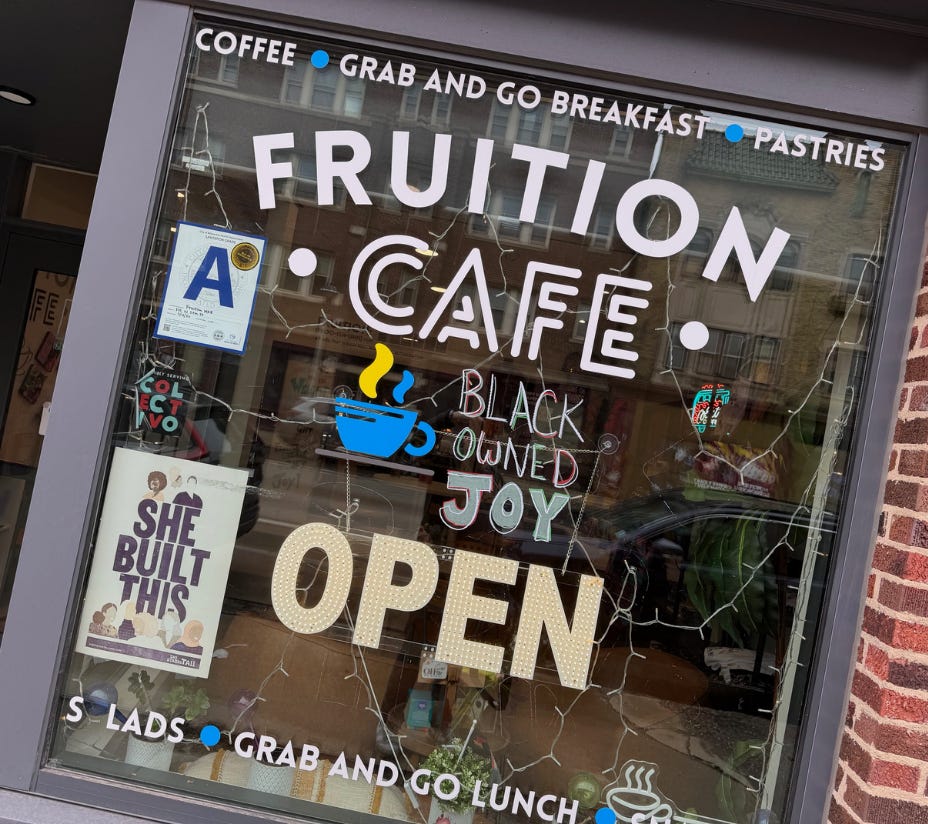
Fruition MKE changed my point of view in a great way. Because as soon I walked into the welcoming space, my original story idea fell apart.
Instead of, “Here are the neighborhoods being left behind,” what I saw was energy. People gathering, making things, and building something with the what’s already around them.
That doesn’t mean investment gaps aren’t real.
What it did mean for me, however, was that I was suddenly less interested in writing about what Milwaukee is forgetting and more interested in writing about what Milwaukee is doing.
Because too much of our tech innovation conversation is shaped by absence.
We don’t have enough venture capital. We don’t have enough founder density. We don’t have enough risk tolerance. We don’t have enough civic alignment. We don’t have enough of the big shiny things other cities have.
Even though some of that is true, I’m convinced that one of Milwaukee’s challenges is that we keep overlooking the value of what is already here.
That’s also something that came up in a recent conversation with Milwaukee founder and my longtime friend, Ivan Rahman.
Ivan talks about Milwaukee with a mix of affection and frustration that, to be honest, I feel too. Early in the conversation, he says he relates to Milwaukee like he relates to his siblings: he loves the city deeply, but there are times he wants to ask, “What are you doing???”
It’s funny, but it also gets at something real. Loving Milwaukee often means seeing its potential so clearly that its self-imposed limitations become even more maddening.
And Ivan uses the word “potential” a lot when talking about Milwaukee.
He points out that the city has major corporations, natural assets, regional proximity, and a geographic position in the middle of some of the Midwest’s biggest metros.
Ivan’s frustration is not that Milwaukee has nothing to work with. It’s that we still work and build in silos.
This idea, which was swirling for me for some time, took hold when Ivan shared the same sentiment a couple of months ago now.
Does our “silo mindset” keep us from seeing what’s around us?
What if some of the neighborhoods we describe as “left behind” actually hold the exact qualities Milwaukee says it wants more of?
Creative energy. Informal networks. Local ownership. Maker mentality. Physical places. A culture of trying things. These are the things we say we value.
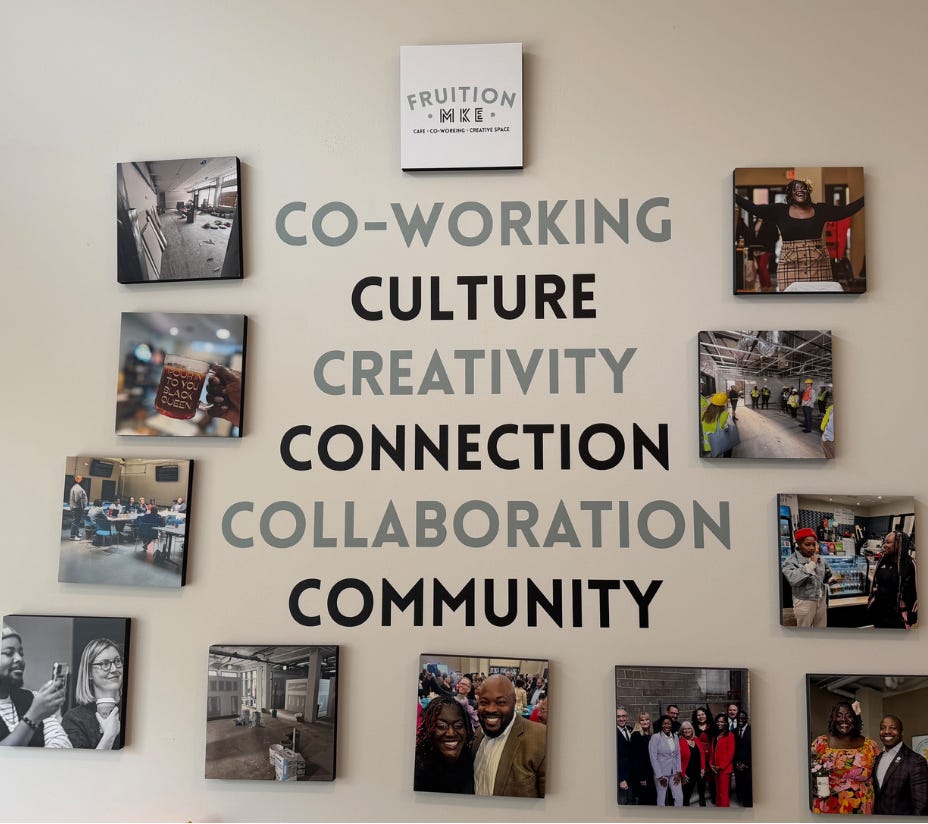
But if we’re looking for a proximity between art, entrepreneurship, commerce, and community, well that doesn’t need to be invented from scratch because it already exists.
These are exactly the things I saw in Walker’s Point when I presented the idea of an Innovation District to Common Council President Jose Perez. And it’s what I see in Fruition MKE.
Ivan says something to me in the conversation that I haven’t stopped thinking about: “innovation doesn’t start from the top, it starts from the bottom up.”
I wonder if there’s a way to meet in the middle and grow in both directions.
We spend a lot of time talking about innovation as if it’s something that has to be announced, branded, master-planned, or blessed before it becomes real.
Some of the most important innovation in this Milwaukee is happening in neighborhood spaces, small businesses, cultural centers, places where people are building practical momentum before anyone gives them the language for it.
Fruition MKE represents a version of Milwaukee that deserves more attention.
A version where the future is built through places that make room for people to gather, test ideas, sell things, host things, and believe their neighborhood is still a place where something can begin.
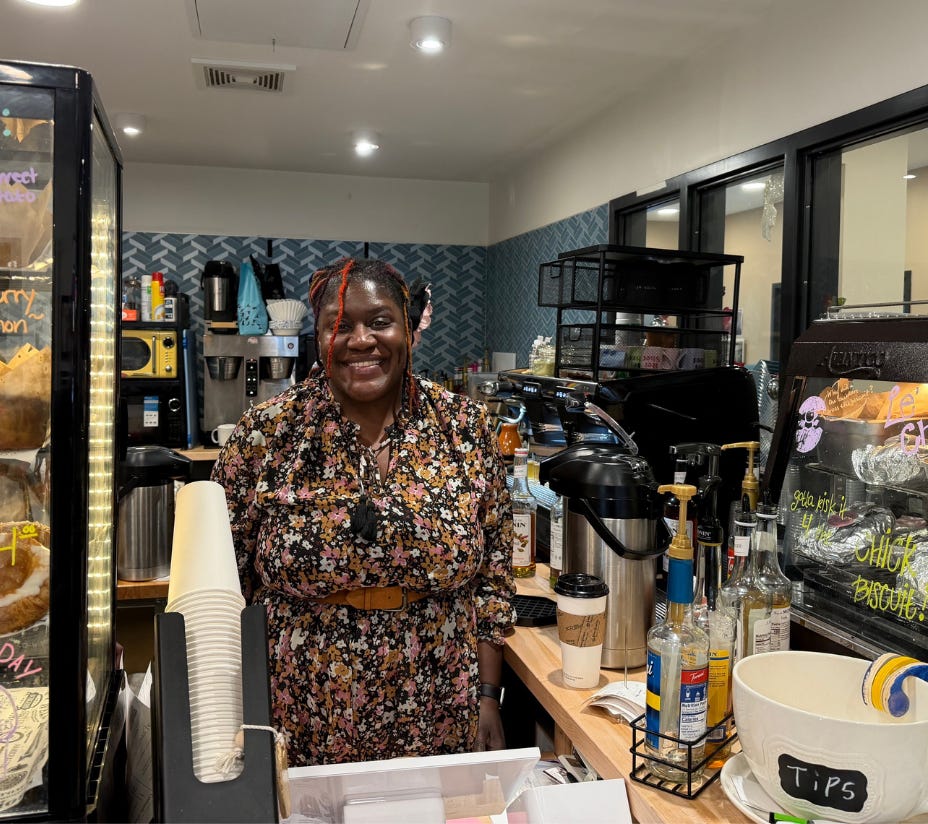
Milwaukee might not need to invent an entirely new future.
But we definitely need to get better at seeing the future already present in parts of the city we’ve trained ourselves to underestimate.
With that, I’ll leave you with a final thought from my conversation with Ivan.
What ambitious readers should notice:
Momentum is not only created in the obvious places.
Some of the most important signals in a city come from people building in neighborhoods and contexts others underestimate.
If you want to understand Milwaukee’s future, train yourself to see value where conventional ecosystem narratives do not.
Love you Milwaukee.
Experience Milwaukee is graciously supported by our partners Concurrency and Secure Compliance Solutions. We are grateful for their partnership.
Great story Steve!
Wow!!! This is a really beautiful piece. Thank you for visiting and experiencing what I wish everyone to experience…possibility, energy and joy.