


On Thursday, January 15, I received a text from my friend Derek Hyde from the Milwaukee Brewers. Derek asked if I’d be up for a trip to sunny Phoenix for a behind the scenes tour of what he and his team are doing in baseball tech. One catch: I had to be there the following Tuesday.
NOTE: I’m purposefully leaving the Brewers and sports tech off this list because that newsletter will be published on Wednesday.
Looking at the snow outside my window, I quickly canceled my planned trip to San Francisco (part of my tech city tour) and moved my energy to Phoenix (thanks for the quick pivot, Genevieve!).
I decided to go to Phoenix only because it was warmer than January in Milwaukee, but also because someone had casually said, “If you care about cities, tech, and where this is all headed, you should spend some time in Phoenix.”
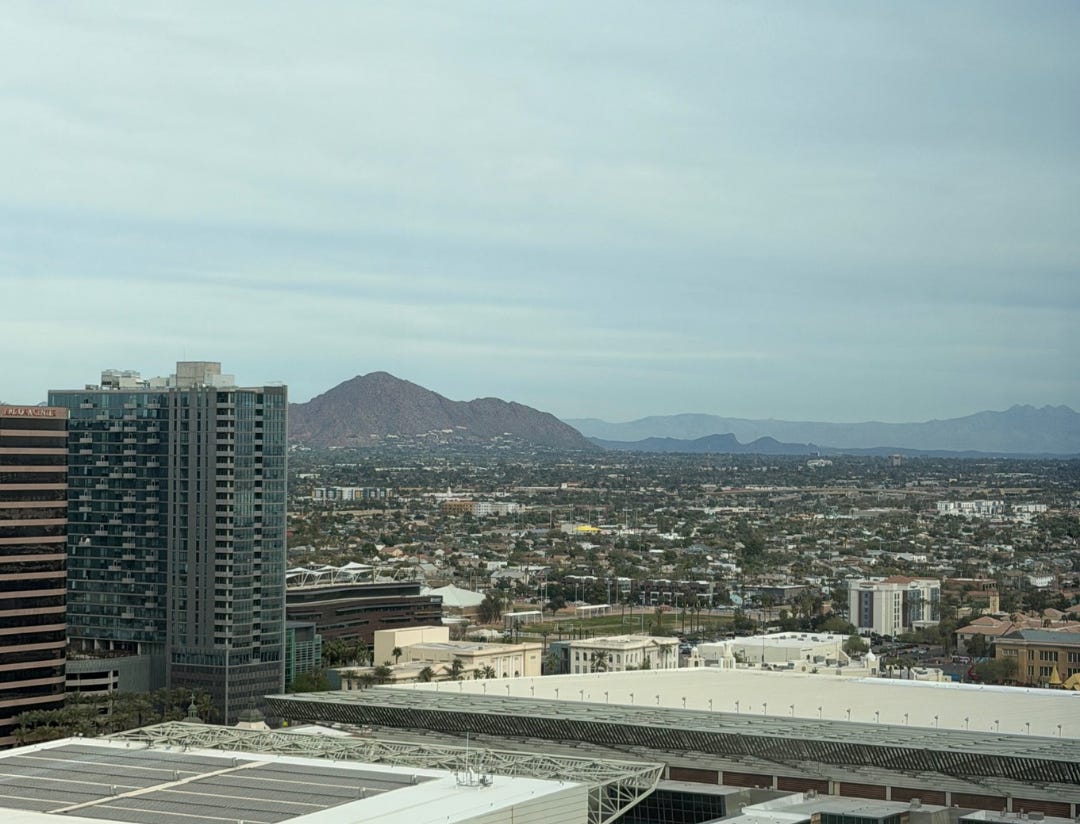
A photo of Phoenix from the Visit Phoenix new offices.
It was clear. Phoenix knows what it is and what it’s becoming.
And that alone separates it from a lot of cities that want to win but haven’t yet decided how.
While there, I didn’t hear that Phoenix was the new or next big thing or the hub of anything. What I did hear was a consistent vision, spoken by people in very different spaces in the tech scene, over and over again.
Ron Price, CEO of Visit Phoenix, lays the framework that I felt around Phoenix.
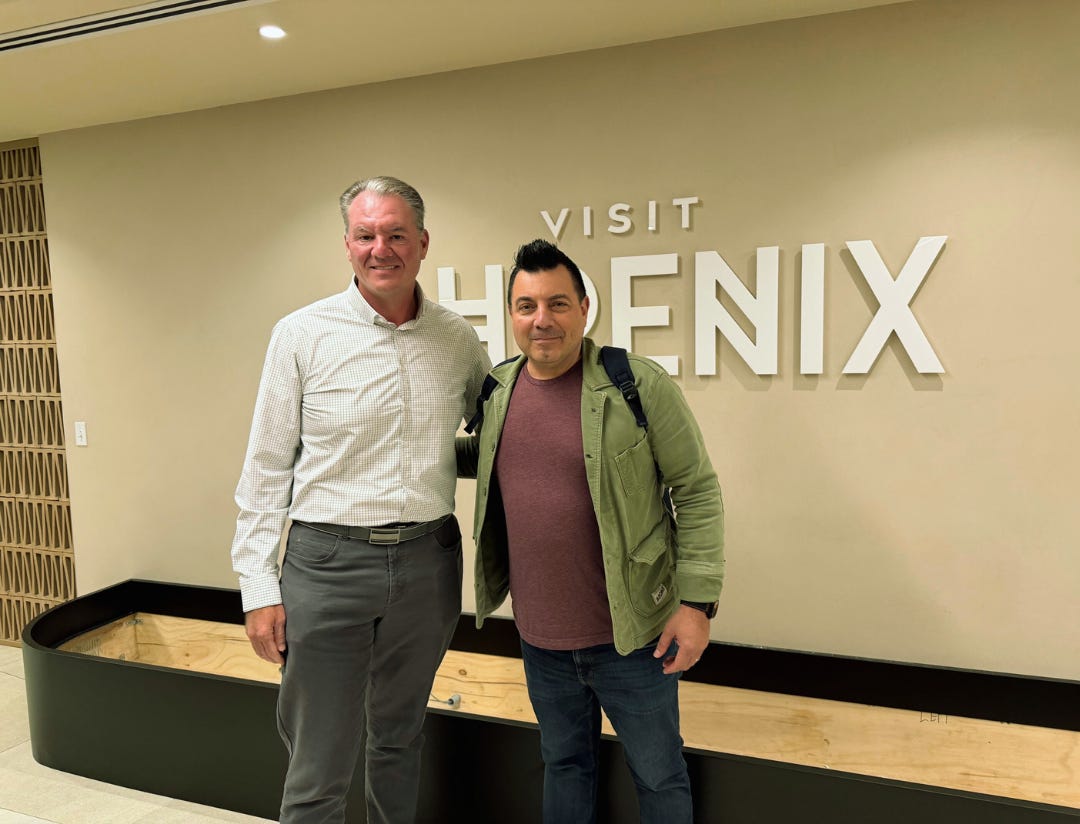
This is me with Ron Price, CEO of Visit Phoenix.
With not much time to plan, thanks to help from my pal Jay Kolbe, and HUGE THANKS to the kindness of all who sat down with me, here’s who I talked to over two days:
Ron Price, CEO of Visit Phoenix
Tanner Bykowski, Founder of Diamond Derby Homerun Park
Chris Loeffler, CEO of Caliber
Adam Gruett, Co-Founder of Smile Big Network
Ben Brockwell, Partner at AZ-VC
Daniela Santangelo, Founder and CEO of Freeway
As I worked my way through these conversations, there was a consistent belief that Phoenix is building for the tech future, not just chasing the present. A belief that growth around technology and business should be intentional and planned. A belief that the city’s role isn’t to wait for innovation to show up, but to create the conditions where it can’t help but stay.
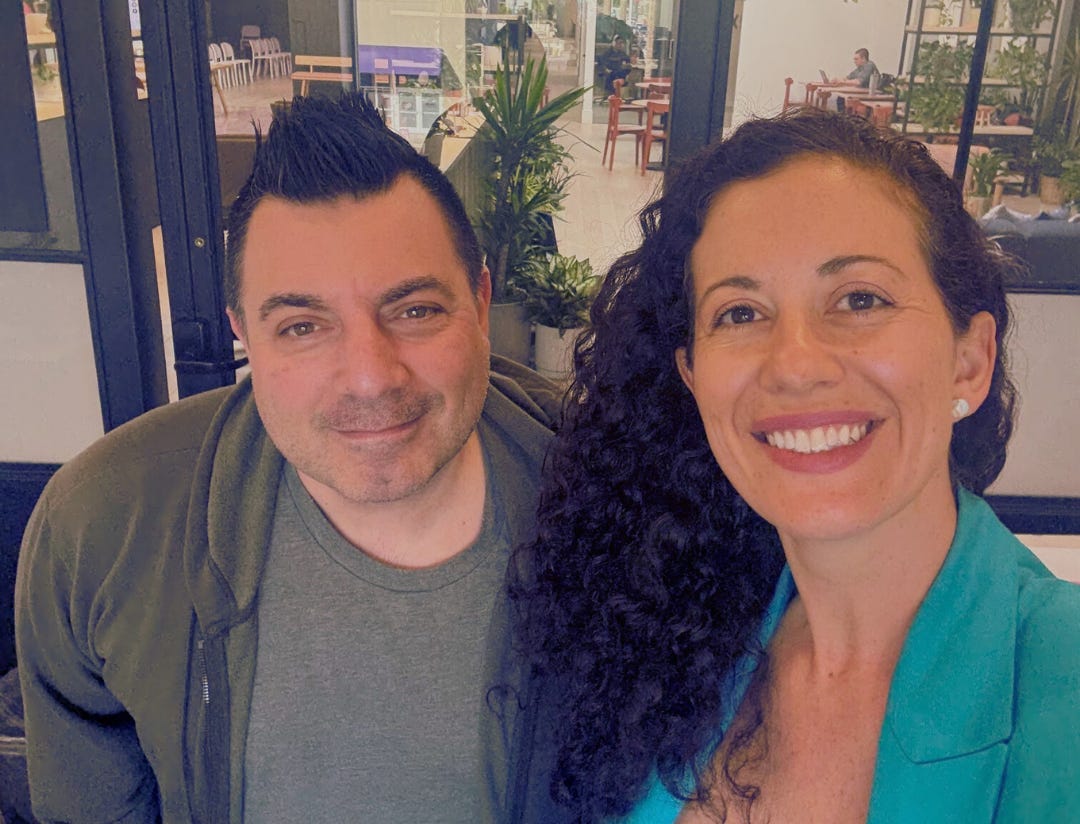
This is me with Daniela Santangelo, Founder and CEO of Freeway.
Phoenix has made a clear choice in how it plans to use the business of technology as one of its key levers for economic growth. Here’s how.
In Phoenix, Arizona State University is central to the story. ASU came up in nearly every conversation. Not as a talent pipeline, but as an active participant in shaping what industries matter here and where the city is investing its energy.
Phoenix universities intentionally add downtown locations. New medical schools, film programs, and immersive technology labs as off the main campus extensions to ensure they’re in the mix of what’s happening. Integrated and tied to the future Phoenix is working toward.
The message is subtle but powerful: the city isn’t just educating students. It’s educating itself into its next economy.
What surprised me most, though, was how “unglamorous” Phoenix’s big vision actually is.
They didn’t start by chasing startups. They started by chasing infrastructure.
Semiconductor manufacturing. Massive fabrication plants. Long-term, capital-intensive investments that some cities shy away from.
But that infrastructure foundation changed everything.
Once the manufacturing base was in place, the rest followed naturally. Supply chains. AI companies. Startups. Aerospace. Health tech. Autonomous vehicles. Global capital. Testing environments. And big time jobs.
Phoenix didn’t try to be the next Silicon Valley. It decided to become essential to where technology is going. There’s a lesson here for cities like Milwaukee, whether we want to hear it or not.
Culturally, Phoenix feels different, too.
With everyone I talked to, everywhere I went, what kept coming to mind was calm intensity.
Adam Gruett, Co-Founder of Smile Big Network, speaks with the calm intensity I heard over and over.
People are friendly and generous with their time, but there’s no mistaking the ambition underneath. Progress feels normal here. Trying something new doesn’t feel like a risk to your reputation. Failure isn’t romanticized, but it isn’t fatal either.
That matters more than we often admit.
Phoenix feels lighter in how it sees failure. Not careless, just less constrained.
You’re allowed to try here. And then try again.
A couple of founders I met with, coincidentally, came to Phoenix from Wisconsin. Neither talked about leaving as an escape, necessarily. They talked about it more as an extension.
Phoenix, for them, was a place to reset, to build confidence, to meet other people who were building, to move a little faster. Adam even said he plans to bring what he learns back home to Milwaukee.
For them, it’s about moving, learning, and building bridges between ecosystems.
Phoenix benefits from that movement. So could Milwaukee.
One of the most impressive things I saw here was clear on-ramps. Places and platforms that exist solely to help people understand what’s happening, who’s involved, and how to plug in. Community organizations that coordinate instead of compete.
Daniela Santangelo, Founder and CEO of Freeway, talks about the paradigm founders should have with investors.
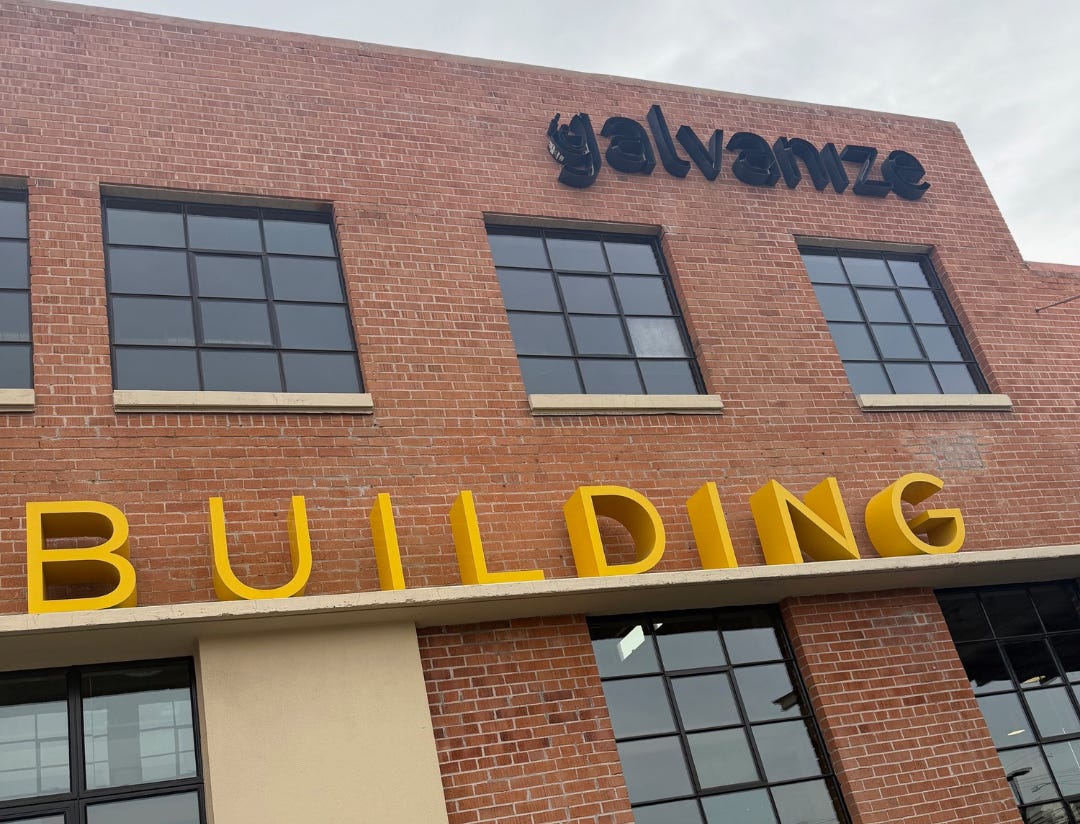
A photo of Galvanize, one of the coworking spaces I toured.
Phoenix hasn’t eliminated friction, but it treats friction like a problem to solve, not a feature to tolerate.
Chris Loeffler, CEO of Caliber, talks about the kind of environment that helps builders build.
That mindset extends to space and community as well. Things are spread out, yes, but they’re also fast.
Approvals happen. Development moves. Real estate is seen not just as buildings, but as culture, collision, and possibility.
Speed matters. And Phoenix respects that.
I don’t think Phoenix is “better” than Milwaukee. But it is clearer. Much clearer.
It has chosen a direction. It has aligned its institutions around that choice. And it has decided, maybe quietly, but certainly collectively, that progress is worth coordinating around.
Milwaukee has real strengths. Deep ones. Manufacturing. Water. Industry at scale. Culture. Talent. History. Community.
What Milwaukee still struggles with is cohesion.
Phoenix doesn’t feel like a city waiting to be discovered. It feels like a city that has already decided, and is calmly executing.
More than the weather, that’s the part worth paying attention to.
What Milwaukee should learn from Phoenix.
Alignment beats scattered energy.
Calm, coordinated execution can create more momentum than louder branding.
Cities grow when enough leaders share a direction and reinforce it consistently.
What ambitious readers should notice.
Strong ecosystems are easier to plug into because they communicate confidence.
Pay attention to places where institutions, leaders, and builders are rowing in the same direction.
If you want Milwaukee to feel more possible, part of the work is helping create that cohesion.
Here’s the full, unfiltered interview with Visit Phoenix CEO Ron Price.
Great research, Steve. Accepting failure as a learning experience, not a dead end is so important.