


Here’s a question I’ve been asking quietly for a while but haven’t really taken public yet: What are we teaching our kids about tech?
Not how to code.
Not what languages to learn.
But what tech is for and who they’re allowed to become because of it.
Why does this matters for Milwaukee’s future?
The next generation’s relationship to technology starts much earlier than most workforce conversations admit. If we want a stronger innovation economy later, we have to care about curiosity, confidence, and exposure now.
And that’s why I’ve started to put this question in front of leaders in Milwaukee’s tech community.
Most recently, with Mason Cook, Managing Director at MasterCraft Ventures (no, not the boat company), talking about startups, risk, and why Milwaukee and Wisconsin continue to struggle toward a meaningful tech startup ecosystem from most sides of the equation.
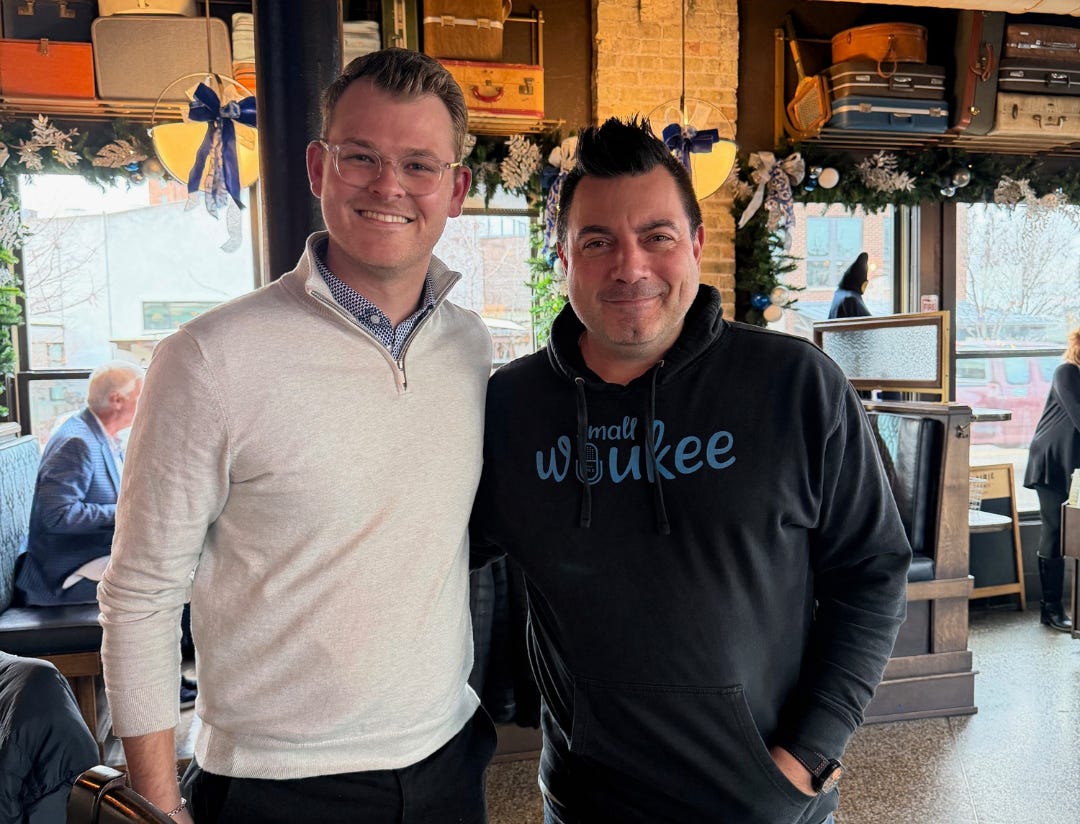
At one point in our conversation, Mason landed on an analogy that hit.
Startup ecosystems, Mason said, are like honey. You can have flowers, pollen, beekeepers, and infrastructure. But without bees, nothing gets made. And in his metaphor, bees are founders.
Listen to Mason’s bee analogy.
(Btw, here is the full, unfiltered and unedited audio recording of our 30 minute conversation.)

That analogy has been stuck in my head ever since.
So I started asking myself:
Who are the bees in Milwaukee?
And more importantly: what systems have we built to help them thrive and make honey?
Risk, through a “first-in capital” lens.
Beyond the bee metaphor, Mason also talked a lot about risk. Specifically from his perspective as a “first-in” investor. At the earliest stage, he said, the only thing he can really evaluate is the person. Not the product. Not the revenue. The person.
Their clarity of thought.
Their obsession with the problem.
Their ability to simplify chaos.
In other words: the bee.
And that’s where Milwaukee’s deeper challenge starts to show itself.
Risk.
Avoiding professional risk is baked deeply into our workplace culture.
That doesn’t come from nowhere.
We’re a city and a state built on strong, stable enterprises. Manufacturing. Healthcare. Financial services. Companies that reward reliability, consistency, and long-term thinking.
But here’s the tension we don’t talk about enough.
Are our career fairs focused on jobs or on problems?
Is coding framed as a skill to get hired or as a tool to build something new?
When tech stories break locally or nationally, are they about our startups or about innovation happening inside our large organizations?
We say we want innovation, yet we systematically reward risk avoidance and failure prevention.
That contradiction matters.
The sequencing problem hiding in plain sight.
So where are we getting off track at the local and state levels? And why don’t we have more bees?
On paper, we should.
With UW Milwaukee, Marquette University, and the Milwaukee School of Engineering (my alma mater), Milwaukee should have a thriving bee population.
Instead, we’ve cultivated beautiful flower gardens that relatively few bees visit.
UWM has the Lubar Entrepreneurship Center yet “career-ready workforce” is the headline message used to recruit students.
Marquette has the 707 Hub and the Kohler Center for Entrepreneurship yet proudly touts a top national ranking for job placement.
MSOE has the Uihlein/Spitzer Center for Innovation and Entrepreneurship (the Innovent Center) yet emphasizes a 99% job placement rate by preparing students to contribute immediately inside corporate environments.
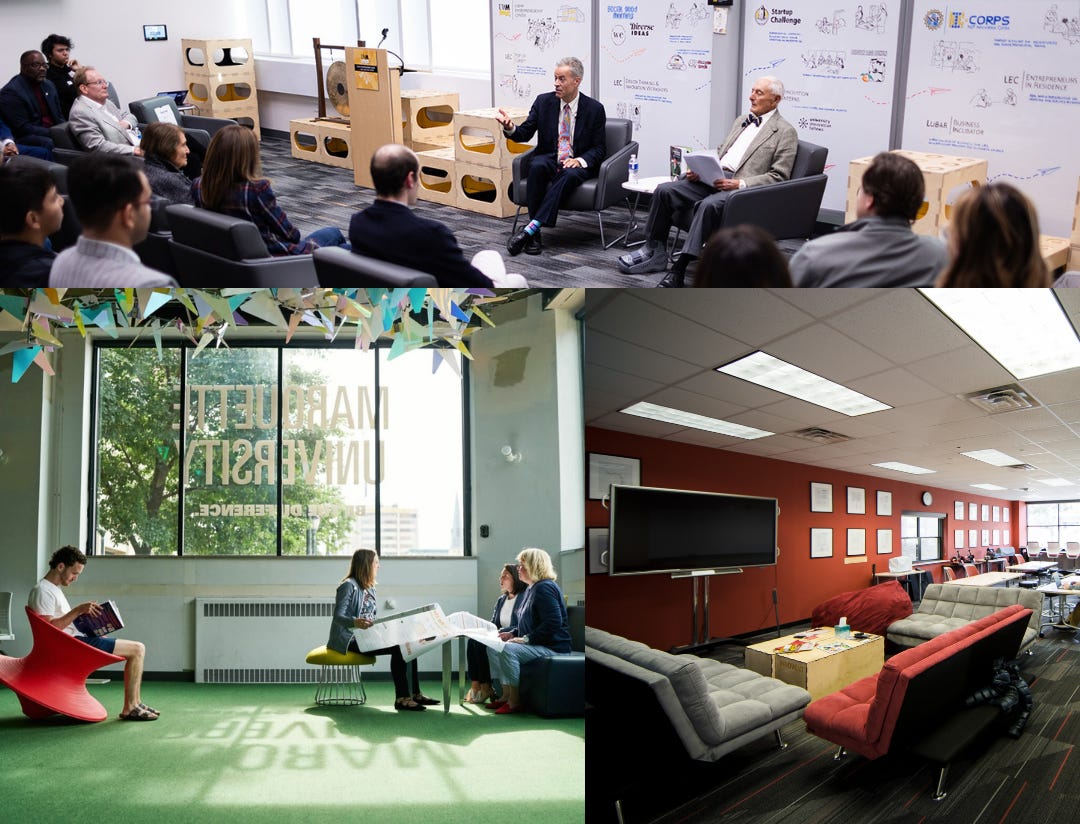
None of this is surprising.
We educate for employment because Milwaukee has a lot of enterprises that hire a lot of tech talent.
But here’s the uncomfortable truth: one of Milwaukee’s biggest hurdles in realizing a booming tech startup ecosystem is our legacy enterprise success.
When enterprise paths are strong, safe, and visible, they become the default.
When wealth is built slowly and privately, risk looks irresponsible.
When control is prized, dilution feels like a threat.
And kids don’t start companies.
So we don’t get bees. Or honey.
So where are the beehives?
They exist. They’re just downstream. Just to name a few…
Black Sheep Group (“innovation speakeasy”), led by David Fockel
These organizations are doing real, necessary work. But the challenge is they’re trying to create bees after we’ve spent years teaching people to be employees.
And that’s the core issue.
Let’s Be(e) Real.
We don’t need every kid to be a founder.
But if we want more honey, we absolutely need more bees.
That means kids need to see founding a tech startup as a legitimate, realistic career path not a reckless detour reserved for a few outliers.
It means early and ongoing education that emphasizes:
Problem discovery
Experimentation
Ownership
Failure without penalty
Because most often when tech startup ecosystems fail it’s because no one teaches kids how to be bees.
Let’s start by changing what our kids believe tech skills can do for them and for Milwaukee.
Here’s what I’m going to do about it.
I do plan to dig deeper into what programs like STEAM Milwaukee, Junior Achievement Wisconsin, i.c.stars, and Islands of Brilliance might be doing in terms of tech entrepreneurship. Could be an opportunity for these organizations I respect.
And, as I mentioned in a previous newsletter, in 2026 I’m visiting a different innovative city each month. Cities that seem to do a good job creating bees, fostering tech innovation, and building strong community around founders.
I want to see how they sequence education, risk, capital, and culture. I want to understand what they do earlier, differently, or more intentionally.
And then I’m bringing it all back to Milwaukee. And I’ll share everything I’m learning here on this Substack.
Not as a blueprint. Not as a comparison meant to shame. But as ideas, patterns, stories, and mistakes we can learn from if we want to build faster, better, and more honestly here.
If we want more honey in Milwaukee, we need more bees.
What ambitious readers should take from this:
Talent pipelines do not start in college or at a first job.
The cities that win long term teach young people to see technology as something they can shape, not just consume.
If you care about Milwaukee’s future, pay attention to how young people are being introduced to problem-solving, creativity, and technical possibility.
Listen to Mason’s point of view on the future of Wisconsin in tech and innovation.
Love you Milwaukee!