


On a crisp, snowy January day at the Eagleknit in the Walker’s Point Innovation District, I was asked to host Founder Friday, sponsored by Mastercraft Ventures.
It was a fireside chat style conversation with David Marcus, Chief Executive Officer and Managing Director of Marcus Investments.
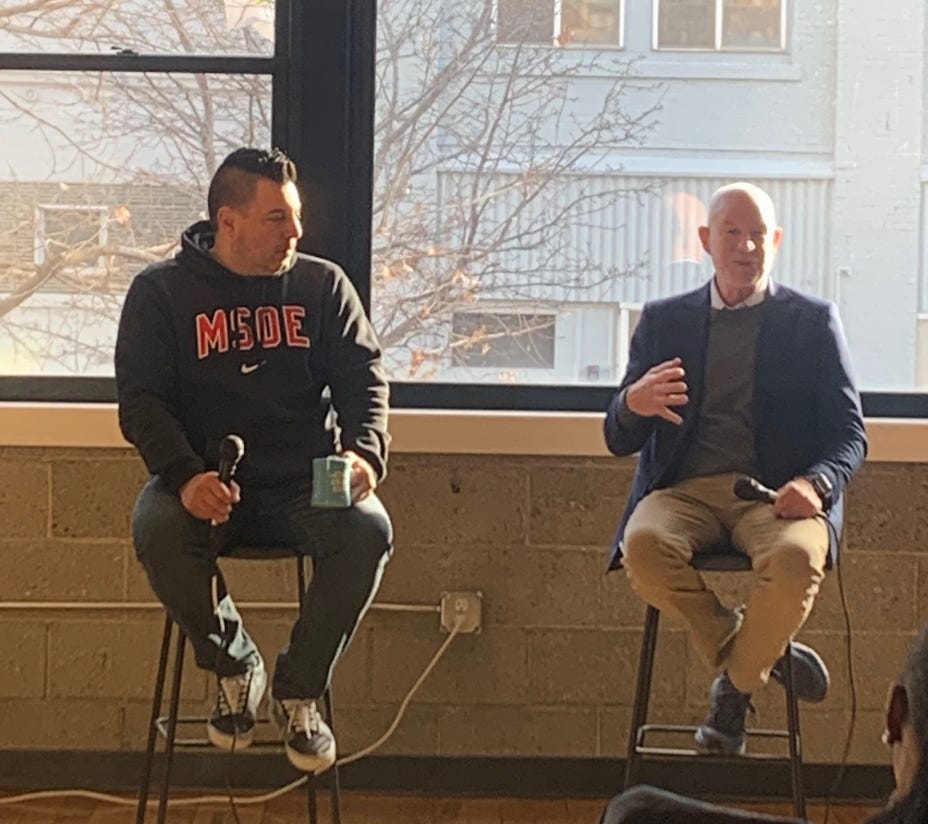
In an enlightening conversation, where an audience of 60+ founders, investors, and tech community supporters from Madison to Kenosha gathered, David said something simple that stuck with me more than any grand theory about entrepreneurship.
He talked about singles.
His grandfather started with one movie theater in Ripon in 1935.
Not a giant company. Not a legacy. One theater. Then another. David said going back there now with his kids helps make the scale of what his grandfather built feel more real. His grandfather didn’t build everything at once. He built one thing, then another, and let them add up over time. Singles.
That feels like a Milwaukee lesson.
A lot of people in Milwaukee talk about building as if the city is waiting for one dramatic unlock.
One breakout founder or one giant investment. Something that comes from the outside and finally tells everyone else Milwaukee matters.
But what David described is something else: accumulation vs. waiting to be discovered. That we need more building of good things that, eventually, people have no choice but to notice. As Manny says, be so great you can’t be ignored.
That thread ran through almost everything David said.
In our chat, David talked about moving to Florida, seeing the internet happen in front of him, and starting a company around something most people still barely understood.
He even wrote a business plan for his dad around the idea that someday there would be a giant online mall where people bought everything. His father sent it back years later with the note that he probably should have invested!
But David was also careful to say that resources are one thing; the daily drive, focus, and dedication to keep going when some days are great and some days suck matters more.
That part matters because it cuts against a lazy local assumption that access explains everything. It doesn’t.

Access helps. Legacy helps. Resources help. But every generation still has to answer its own question: what am I actually building and am I willing to keep going when it gets hard?
David gave one answer to that question in a place people do not always expect to find it: restaurants.
He said he spends most of his time in the restaurants because that is where he gets the most feedback. He talked about loving the people, loving the culture, and seeing the business as something that pays him in more than one way, particularly in the way customers respond to what gets built and in whether employees actually enjoy what they do.
He also described restaurants as one of the few businesses that still offer real entry points for people just getting started: places to learn, coworkers, customers, money, pressure, and pride, and to leave with a real sense of accomplishment.
That stood out to me because it’s bigger than hospitality. It’s really a point about Milwaukee.
We need more places where people can enter, contribute, get sharper, and feel momentum early.
Not just polished places. Real environments, too, where people learn how to carry responsibility and build trust. Davide talked about restaurants, but he was also talking about the kind of city Milwaukee has a chance to be.
He said something else I wish more leaders here would sit with.
I asked whether his commitment to Milwaukee gives his businesses a competitive advantage. His answer was, no.
At least not in the sentimental way people might want to believe.
Customers do not reward you because you love the city. They reward you for being great at whatever it is you do and building the kind of culture people can feel.
His point was direct: businesses are empty buildings without people, and if you build a strong culture, people work harder and care more.
That is one of the best arguments for Milwaukee I have heard in a while.
Because loving Milwaukee is not enough.Wanting the city to win is not enough. Talking about community is not enough.
The city gets stronger when people build things others actually want.
David described that balance clearly: build environments that are approachable, but still elevated in food and hospitality, and make people feel comfortable when they walk in.

That is a useful standard for more than restaurants. It applies to companies, networks, institutions, and rooms.
A lot of Milwaukee’s future may come down to whether we can keep building things with that combination: quality without ego, ambition without distance.
Then he said the thing I probably needed most from the whole conversation.
When asked what advice he gives his kids, Marcus said: don’t wait for someone to invite you to be the adult. Speak up. Share your opinion. People want to hear from you more than you think.
That line pairs perfectly with his answer to another question: what is the biggest advantage to building in Milwaukee?
His answer: the city’s size.
People are approachable here. You can get to them. You can make the call, knock on the door, find your way into the conversation. The people who are willing to do that usually make the most progress. Milwaukee is still small enough, in his words, that you can get to people and find your way into connection.
That might be the most important thing ambitious people in this city still underestimate.
Milwaukee is not perfect. The ecosystem is not fully built. The pathways are not always obvious. But the distance between ambition and access can still be shorter here than in a lot of bigger cities. And that matters.
In Milwaukee, proximity becomes a meeting, moves to a relationship, and by then, a chance. Much more often than people think.
David also talked about what he’s seen change in Milwaukee over the last 20 years.
He made a practical point that national players have not always aimed here first, which has left more room for strong local operators to build meaningful businesses.
That is not a consolation prize, it's actually an advantage. If we know how to use it.
Because one version of Milwaukee’s future is a city that keeps waiting for outside validation. But a better version is a city that keeps producing people, places, and companies that are so good that validation follows.
It’s a much steadier idea: build well, keep going, learn from mistakes, pay the ignorance tax once, and let enough good singles add up.
I understand that might not sound flashy. But it’s how Milwaukee actually wins.
What ambitious readers should take from this:
Milwaukee’s advantage is still proximity. You can get to people here faster than you think.
Culture is not soft. It’s often the thing that makes a business durable.
You don’t need one giant break to build something meaningful. You need enough good singles that eventually add up.
Love you Milwaukee.