


NOTE: This article is not an endorsement for Missy Hughes. The purpose was to have a conversation about her vision for technology and innovation for the state. I have asked all eight Wisconsin gubernatorial candidates to join me on this platform for the same conversation and coverage. Five have responded.
The full audio of my conversation with Missy can be found at the end of this article.
Missy’s Quick Bio:
Most recently was secretary and CEO of the Wisconsin Economic Development Corporation (WEDC) where she worked on attracting, retaining, and growing businesses across the state.
Prior to the WEDC role Missy was Chief Mission Officer and General Counsel at Organic Valley helping grow the company to $1 billion in sales.
Missy’s experience with startups, capital, AI, and business growth felt less like campaign BS and more like someone actually speaking the language of the work.
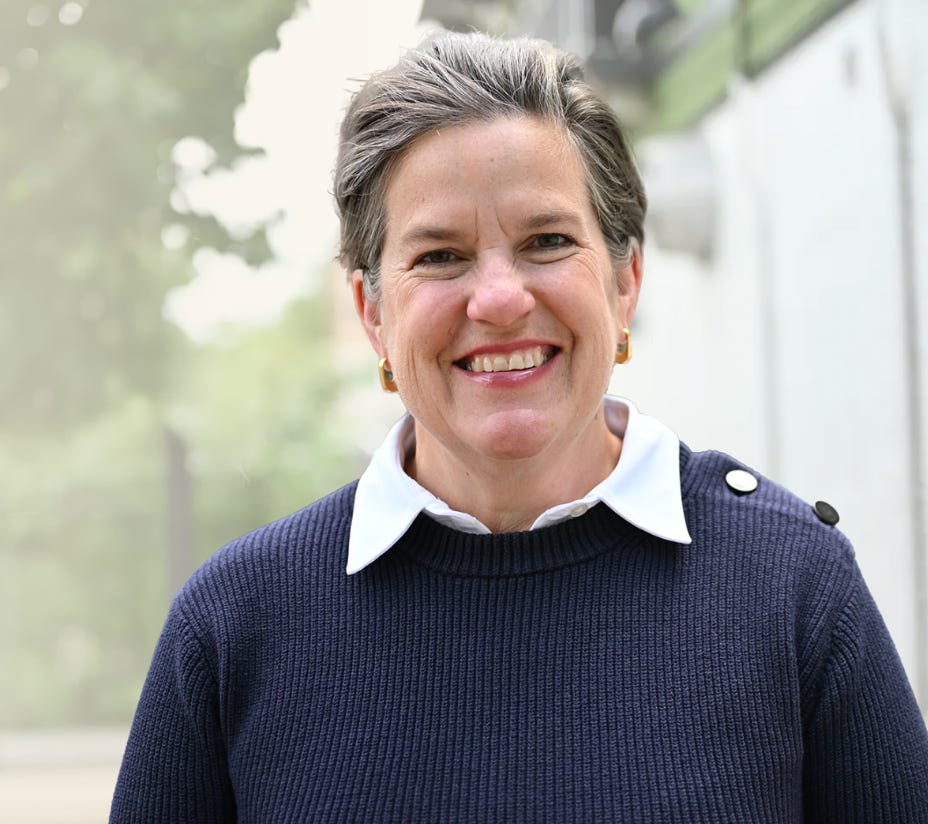
Whenever I’m talking with leaders about tech and innovation, I’m always super interested in how much they actually understand how businesses start, what helps them grow, and why some cities keep more of what they build than others.
In my conversation with Missy Hughes, one of seven democrats running for governor in Wisconsin, she brought an authentic depth of understanding and experience around these topics.
Not just as someone who’s kind of absorbed a point of view from visiting shop floors and board rooms. More like someone who’s lived it. Someone who has actually built the infrastructure to grow and keep businesses in Wisconsin.
I’ve spent the last 20 years around Milwaukee startups, tech ideas, founders, and community-building. Over that time, I’ve heard a lot of people say they support innovation. Yet they avoid risk, failure, and they don’t invest where it actually makes a difference.
Not Missy. She embraces these ideals and then tops it off with specifics on what the state should actually do.
If you listen to the full interview, Missy explains that we don’t have an idea problem, we have a magnet problem.
Missy talks about how, over the last 15 to 20 years, Wisconsin has been losing too often to the business resource magnets in other places, especially on the coasts.
Her answer was not a charming theory.
She pointed directly to the work she helped lead at WEDC to create Wisconsin’s own magnet. Especially around access to the moola.
She turned $50 million from the U.S. Treasury into a $100 million Wisconsin Investment Fund by matching it with private investment. A fund focused exclusively to keep more of Wisconsin’s companies here as they start and grow.
That’s the kind of specificity I look for.
And it wasn’t the only example.
I found something else interesting, and I’ve never really heard anyone frame startups like Missy did. Rather than limiting the mental image to laptops and basements and 20 year olds, she talked about Epic, Oshkosh, Snap-on, Milwaukee Tool, and Organic Valley as OG startup businesses that also needed (and still need) time to take ideas to scale.
Ok, I’ve got one more point to make about the conversation and then you can listen to it.
I challenged her with: “how do we better align our numerous large companies with startups so founders have a better roadmap of problems they can work to solve here in our state?”
In a moment where I felt like she and I were riffing on strategy, Missy did the ol’ “yes and” on my thought and took it further.
Her add on: Wisconsin could do a much better job helping large incumbent companies spin out ideas and businesses that are roaming around their own operations.
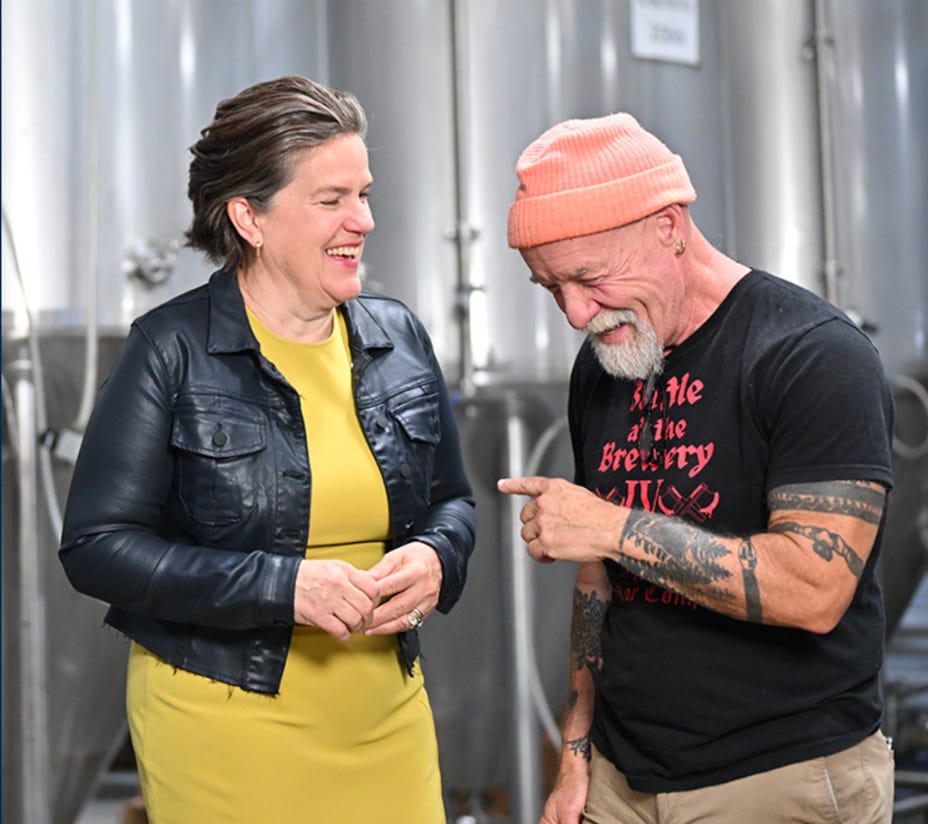
She talked about people on the inside of these companies, manufacturing operations, etc., who are solving practical problems, and the need for the state to create more of an “idea factory” mindset. One where people understand that if they have an idea, it can become a business, and the state should help make that possible.
Why does this matter?
Because if Wisconsin is going to produce more meaningful startup and innovation momentum, it can’t just rely on a small corner of the ecosystem. It has to create more movement between big companies, operators, inventors, researchers, and would-be founders.
A lot of us have been saying this for a very long time. In relief, finally, the urgency has found its way to the top.
And after 20 years of building in and around this space, well, I think you can imagine how I feel about that.
Listen to my conversation with Missy Hughes.
Experience Milwaukee is sponsored by Concurrency and Secure Compliance Solutions.